
In 2012, ZTE India posted a small rate of growth, realising revenues of $700 million, around half the $1.5 billion it received in 2009, a write up in the state run China Daily titled 'ZTE banks Indian telecom market' said.

Chinese telecom equipment maker ZTE is looking at setting up a manufacturing plant in India even as operators have informed the company that it is yet to clear the security hurdles.

India on Thursday sought clarifications and additional information from leading Chinese telecom manufacturing firm ZTE on the issue of security clearance to their equipment.

ZTE Worldwide has plans to launch high-end handsets on Microsoft and Android platforms as well.

Telecom equipment maker ZTE had to overcome strong prejudices to establish itself in India.

'The huge amount of investments being made by telcos in India for telecom gear, there is no way this demand could be met only by Europeans.' 'The Chinese are quick in installation and offer great value for money.'

The government believes firms which are subject to China's laws could be forced to hand over information to Beijing's security services.

The government is concerned about the spyware and malware associated with imported telecom gear. India had demanded that global telecom gear makers place source codes and design elements in an escrow account.

Given the security dilemma prevailing between India and China, India should curb the operation of Chinese telecom companies in India, asserts Dr Rup Narayan Das.

Will open radio access network technology (O-RAN) disrupt the way 5G networks roll out in the country? After all, it promises to offer a substantially lower capital cost, enables the choice of an array of vendors, and provides more network flexibility - all very important for telcos who expect to invest over Rs 60,000 crore to roll out a pan-India 5G network and that's without spectrum costs. But more importantly, it counters the stranglehold of global telecom gear makers such as Ericsson, Nokia, and Samsung over telcos to whom they sell propriety technology and bundled hardware and software.
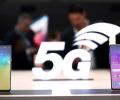
With Chinese companies Huawei and ZTE excluded from participating in the 5G roll out, their absence leaves a vacuum in the market which will have to be filled by three vendors: Ericsson, Nokia and Samsung.

The income tax department has found alleged manipulation of account books for reducing taxable income in India by Chinese telecom company Huawei whom it raided recently, sources said on Thursday. The searches were conducted on February 15 at the main business and residential premises of "key office bearers" of a multi-national group, engaged in distribution of telecom products and providing captive software development services, the CBDT said in a statement. Sources identified the company as Huawei.
Indian telecom operators came out in open support of Chinese equipment makers, saying the government cannot deprive Indian consumers of the cutting-edge technology which these companies offer by denying security clearance to them.
The Income-tax department has conducted searches at multiple premises of Chinese telecom company Huawei in the country as part of a tax evasion investigation, official sources said on Wednesday. The raids were launched at the company's premises in Delhi, Gurugram (Haryana) and Bengaluru in Karnataka on Tuesday. Sources said the officials looked at financial documents, account books and company records as part of a tax evasion investigation against the company, its Indian businesses and overseas transactions.
Reliance Jio is close to finalising its contract with telecom gear maker Ericsson to roll out its 5G network in Mumbai and Maharashtra and Kolkata and West Bengal in the first phase of its launch in October. And it is going with Nokia for the lucrative Delhi circle, and Chennai, which includes Tamil Nadu, say sources aware of the development. This is the first time that Jio is opting for multiple vendors.
The announcement quells fears among some telcos that Chinese players might be banned from participating in 5G trials and roll outs.

Breaking its silence on reports that Chinese telecom equipment makers are being banned in India on security reasons, Beijing on Monday urged New Delhi to remove restrictions and said such curbs amount to discrimination.
Telecom operator Vodafone Idea is in advance stages of processing order for network capacity expansion in six circles through Chinese telecom gear makers, according to industry sources aware of the development. The order will be only for expansion of existing telecom network capacity where the contract was already awarded to the Chinese vendors, according to the sources.

Several factors have held India back. One is DoT policy somersaults and lack of clarity on whether to or not to ban Chinese gear makers.

Govt likely to make security clearance mandatory for telcos irrespective of equity holding before giving licences; DoT members to meet today.

He said that the Communist Party of China has used the COVID-19 pandemic as a smokescreen for ratcheting up their oppression of Hong Kong and advancing their control and influence throughout the region.
The move comes against the backdrop of the US and some of its allies banning the purchase of Chinese telecom gear over security concerns and pressuring other countries to follow suit.
Led by Huawei Technologies and ZTE, Chinese manufacturers are challenging the domination of European equipment-makers by grabbing contracts (some of which are in advanced stages of negotiations) worth over $2 billion in 2008 -- nearly one thirds of the Indian market of around $6 billion.
Investment announcement for $100 bn over 5 years likely.
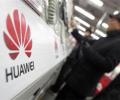
There were reports of a mobile tower being impacted a few months ago in coastal area of Andhra Pradesh that was attributed to hacking by the company's engineers.
Chinese telecommunication equipment company ZTE Corporation on Friday said it expects to set up a research and development centre in Bangalore by the year-end.

Patent fees will likely squeeze margins, and in turn the company's valuation.
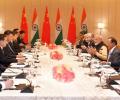
China had been trying hard to enter the Indian market, without opening its own to Indian products. There is an economic crisis in India-China relations that the Chennai Connect barely scratched the surface, points out Srikanth Kondapalli.

All eyes this year, however, are on Nokia's latest launches.
The sub-$100 smartphone market is dominated by Google's Android operating system, which has lower licensing costs, and runs cheaper hardware.

Chinese telecom gear giant Huawei Technologies has sought permission for access to the government's 'Trusted Telecom Portal' which went live on June 15 so that it can share details about the telecom products which telecom service providers have agreed to buy from it. The move is significant as sources close to the development say that, according to Chinese telecom companies' interpretation, the new National Security Directive on the telecom sector does not in any way prohibit them from participating in the process of selling telecom equipment of any kind to private telcos. The firm is waiting for a response from the government. It declined to comment.

'It is in electronics that the gap between where we are and where we need to be is most obvious and most persistent.' 'It is not only a national security issue, but also a commercial issue,' argues Rajeev Srinivasan.
Just to promote govt's policy of Make in India, BSNL said, it cannot afford to procure sub-standard equipment from inexperienced companies, not having proven technology. BSNL complained that when competitors were procuring world-class 4G equipment from experienced vendors, why should BSNL be compelled to procure locally.

India was the second largest filer of international trademark applications among the BRICS nations in 2014.
A high-level meeting will be convened soon to decide on probing the India operations of Chinese Telecom companies -- 'Huawei' and 'ZTE' -- against the backdrop of the US calling the two firms a threat to American national security.

Following the footsteps of Motorola, Chinese handset maker Xiaomi is also teaming up with e-Commerce major Flipkart to launch its handsets in India.
Leading Chinese telecom equipment manufacturers, Huawei Technologies Co Ltd and ZTE Corporation, have launched an aggressive 'Indianisation' drive. The two companies are replacing Chinese nationals with Indians on their board of directors. The move is seen as an attempt by the companies to change the public perception in India, where Chinese firms are often viewed with suspicion. This would also make it easy for the firms to do business in India.

Chinese equipment contracts had been given by many public sector undertakings and government companies for their networks, even in sensitive places such as the north east.

With China's export markets shrinking in US and EU, its businessmen are increasingly turning to India, making a mark on the fast-evolving Indian markets, a report in the Chinese official media said.
 © 2026 Rediff.com - Investor Information - Advertise with us - Disclaimer - Privacy Policy - Sitemap - Feedback - About us - Terms of use - Grievances